
Strategy Facilitation and Executive Coaching

Posts by Matt Hately

The 2025 Formula 1 season is finally here! In F1, drivers can deploy their DRS—Drag Reduction System—to reduce aerodynamic drag and increase top speed on straightaways (subject to a set of conditions and rules which we won’t discuss here, but I’d be happy to debate offline!)

In the spirit of speed and efficiency, I’d like to introduce a DRS of my own: the Drama Reduction System—a framework for reducing unnecessary workplace drama so your team can move faster.

Where Does Workplace Drama Come From?

Drama doesn’t just slow down decision-making; it drains energy, creates distractions, and erodes trust. But where does it come from?

1. Lack of Direction and Alignment

A friend once asked me, “Why were things so dramatic in high school?” The answer: because most of us didn’t really know why we were there or where we were going. Businesses are no different.

  • If your company’s mission and vision are unclear, confusion and frustration fill the gap.
  • If teams don’t know what they’re working toward, every decision becomes a debate.

2. Poor Communication & Miscommunication

  • Reading unintended tone or intent into emails
  • Misunderstandings due to lack of context
  • Failing to see another person’s perspective (also known as not listening)

3. “Us vs. Them” Mentality (Ego & Silos)

  • Thinking, “We’re doing great; it’s those guys over there who are the problem.”
  • Blaming other teams or departments rather than collaborating

The Cost of Drama

When drama takes over, productivity plummets. Here’s what happens:

  • Distraction & Lost Focus – Drama diverts attention from actual work.
  • Low Energy & Motivation – Constant friction wears people down.
  • Mental Churn – Instead of focusing on work, people replay arguments in their heads, lose sleep, and second-guess interactions.

How to Recognize Drama

Disagreements and debates are healthy—some of the best ideas come from spirited discussions. But when does it tip into drama?

  • We talk over each other in meetings
  • People are entrenched in their views and stop listening
  • Email or Slack threads that spiral into endless arguments
  • Grudges and lingering resentment
  • Overreactions to small issues (was that argument really about forgetting to put the toilet seat down?)

Deploying Your Drama Reduction System (DRS)

Eliminating drama isn’t hard – most people would prefer collaboration over altercation – but it does take some deliberate leadership and for someone to set the example. Here’s how to activate your DRS:

1. Seek to Understand

We have two ears and one mouth for a reason. Ask questions and listen first. I love the Vistage method for processing complex issues, which always starts with 5 minutes of strictly clarifying questions before the group is allowed to jump into solution-mode.

2. Choose the Right Medium

  • If an email or text thread goes back and forth more than twice, pick up the phone.
  • Use email, Slack, and text messages for status updates, heads-ups, and kudos—not for nuanced conversations.
  • People read tone into emails that isn’t there. If you’re the writer, avoid ambiguity and be brief. If you’re the reader, re-read the email in a different tone and see if it changes your interpretation. Or better yet, pick up the phone.

3. Create Clarity

  • Try pausing to restate the discussion as a question – what is it we’re trying to solve for, or what are we trying to improve?
  • Check in – how is your message being received? Ask the listener what they heard. Is it what you intended?
  • If you are the CEO or part of the ELT, every minute you spend clarifying the vision, mission, and values pays dividends in avoiding drama. When people are clear on where they are headed, and what’s expected of them, they spend less time arguing and churning and more time aligning and executing.

4. Assume Good Intent

Start from the belief that people are trying to do the right thing. If you frame communication this way, you’re more likely to engage constructively instead of assuming bad faith. Most of the time, people are trying to do the right thing.

5. Take 50/50 Ownership

In any conflict, assume you own at least 50% of the problem. It doesn’t matter if it’s actually 60/40 or 25/75 – framing it as equal share, and taking responsibility for your role helps de-escalate and move to a solution.

6. Learn to Let Go

  • Are you arguing because it matters, or because you want to be right?
  • If it doesn’t significantly impact the business, let it go.
  • Don’t get too caught up in the how – focus on the outcome.

The DRS Payoff: Faster Execution, Less Stress, More Fun

Some companies have the right product, the right people, and great positioning—but they make things harder than they need to be. The constant drama, culture clashes, and misunderstandings slow them down. By deploying their DRS, they move faster, get more done, and enjoy the process a whole lot more. Your business doesn’t need unnecessary drag.

Leave a comment

If you’ve ever sat in an inbox full of long-winded, unclear, or rambling emails, or had to spend time endlessly scrolling through a discussion on Slack trying to figure out the point, you know how much time is wasted. Poorly written messages create confusion, back-and-forth exchanges, and sometimes, they just get ignored.

Your goal? Write emails and messages that people actually read, understand, and act on—without them having to dig through paragraphs of fluff.

Here’s how. Note that I’ll make this specific to email, but the same concepts apply to all kinds of written messages:

1. Make the Subject Line Work for You

Your subject line is your email’s headline. It should be:

  • Clear: “Q2 Budget Approval Needed by Friday”
  • Action-Oriented: “Review Required: Marketing Proposal (Need Feedback by Wed)”
  • To the Point: If someone can’t tell what your email is about from the subject line, rewrite it.

2. Start With What You Need

People skim emails. If they have to dig for the point, you’ve lost them.

  • Bad: “Hope you’re doing well! I wanted to reach out because we’ve been working on the Q2 budget and have some thoughts on the allocations. We’re wondering if you have any time to review it?”
  • Better: “Can you approve the Q2 budget by Friday? Details below.”

Put your ask right at the top. If you’re giving information instead of asking for something, state that clearly: “FYI – Updated Timeline for Product Launch (See Below).”

3. Be Specific – What, When, Who?

If you need something, spell it out. “Let me know your thoughts” is useless. What thoughts? By when?
Good: “Please review the attached proposal and send your feedback by EOD Thursday.”
Bad: “Let me know if you have any thoughts on this.”

4. Trim the Recipient List

Before you hit “Send,” ask yourself:

  • Who actually needs to see this?
  • Will this email add value for them?
  • Am I just CC’ing people to cover my ass?

Too many people on an email means no one feels responsible. Keep it tight.

5. Background and Context Goes Last

People don’t need a novel before they know what you’re asking. Get to the point, then provide details for those who need them.

Good:

Subject: Approval Needed: Q2 Budget (Due Friday)

Can you review and approve the Q2 budget by Friday?

  • Total spend: $250K (breakdown below)
  • Main changes: Increased ad spend, reduced events budget
  • See attached: Full breakdown in Excel

Context: We adjusted based on Q1 performance and feedback from Finance. Let me know if you have questions.

This way, they see the key info first, and can scroll for details if they need them.

6. Use Bullets and Bold Key Points

No one wants to read a giant wall of text. Make it scannable:

  • Action items: Who needs to do what?
  • Deadlines: By when?
  • Key takeaways: What do they need to know?

If someone only skims your email, they should still get the point.

7. Should This Even Be an Email?

Before you type, ask yourself:

  • Are we brainstorming or discussing strategy? Have a meeting.
  • Is this feedback that could get misinterpreted? Talk in person.
  • Is this a back-and-forth exchange? Pick up the phone.

A good rule of thumb: If an email goes back and forth more than twice, stop typing and call the person.


Bad Email vs. Good Email

Bad Email (Confusing, Long-Winded, No Clear Ask):

Subject: Quick Question

Hey everyone,

Hope you’re all doing well! I wanted to check in because we’ve been looking at the Q2 budget numbers and there are some changes from last quarter. We think we might need to allocate more to advertising and cut back a bit on events, but we’re not totally sure yet. Also, Finance had some feedback, which I’ve summarized in the document attached. Could you take a look when you get a chance? Let me know what you think.

Thanks!

Good Email (Clear, Concise, Actionable):

Subject: Approval Needed: Q2 Budget (Due Friday)

Hi team,

Can you review and approve the Q2 budget by Friday?

Key changes:

  • Ad spend up 10% (based on Q1 performance)
  • Events budget down 15% (low ROI last quarter)
  • Finance feedback incorporated (see attached)

Next Steps:

  • Alex: Approve or request changes by Friday
  • Jordan: Adjust numbers in final report after approval

Let me know if you have any concerns.

Thanks,
Matt


Bottom Line

Before you send an email, ask yourself:
✅ Is the subject clear?
✅ Did I get to the point immediately?
✅ Did I include only the people who need to see it?
✅ Is it scannable (bullets, bolding, clear sections)?
✅ Would this be better as a conversation?

Write emails that work for people, not against them. More clarity, less back-and-forth, and no wasted time.

Now go clean up your inbox.

Leave a comment

And why the compliment sandwich is BS.

Your job as a leader and manager boils down to three things:

  • communicate goals and direction
  • set expectations
  • give feedback

I’m sure you do a lot of other stuff in the day, and it feels like you’re in meetings back-to-back, but most everything you do should somehow fall into each of these categories. For example, when you’re in a meeting with your executive team or your peers, you’re gathering information on the direction and expectations, and when in meetings with your team or in 1:1s, you’re looking for every opportunity to either clarify direction, set expectations, or give feedback. When you’re devising metrics, you’re setting expectations and building the framework for objective feedback.

I could argue that giving feedback is the most important – as long as YOU are clear on where the team needs to be headed, and what YOU expect, you can manage and orient your team through feedback.

Unfortunately, giving feedback is, in my experience, the skill lacking most in managers and leaders. Many leaders have a “set it and forget it” mentality – they do a good job communicating the vision, but they expect their team to simply go forth and execute. If they do give feedback, they’re saving it for annual reviews.

Great feedback, on the other hand, is:

  • specific
  • actionable
  • timely

Be thoughtful and specific with your feedback. “Good job” is pretty much useless as feedback. Good job at what? What part? Contrast that with “Great job at managing that customer interaction. I really appreciate the way you listened with empathy to their concerns, and addressed each one thoughtfully. That person will be a customer for life.”

Feedback also needs to be actionable – what is it you want them to keep doing or stop doing? For example, “I noticed you got into an argument over email with Joe in sales. Did you notice it escalated quickly, and went back and forth for two days? It’s easy to misunderstand someone over email, and impossible to read cues. From now on, if an email goes back and forth more than once, I’d like you to call the person, or set a meeting to talk about it in person. Typically you’ll resolve things much faster in person.”

And most importantly, feedback needs to be timely. By the time you address your praise or concern in a yearly performance review, we’ve long since forgotten the specifics, or worse, we remember them differently. Or, we’ve learned the lesson and the feedback is now a moot point. If it can’t be addressed in the moment, schedule a call or meeting to discuss the feedback no more than a day later.

Some managers have an attitude that “If I haven’t told you you’re doing something wrong, then you’re doing a good job”. This is also useless, and a wasted opportunity. Good feedback is much more powerful than negative. As human beings, we remember positive reinforcement much more than we do negative feedback. Whenever you see actions and behaviors you want to see more of, point it out.

Which brings me to:

Praise in public, scorn in private.

Whenever you can praise someone in public, do it. Not only will you be reinforcing the right behaviors, but it’s an opportunity to reinforce your expectations with the whole team. For example “You know how I’m always saying we need to be proactive. I want to give Jed some kudos – the minute our supplier was overdue in sending the part, he got straight on the phone with our them. He didn’t wait an extra day or two to see if it would show up, and he didn’t email them hoping for an answer sometime this week. He dealt with it immediately. It turns out our supplier simply forgot. They’re rushing the part overnight and we’ll have it tomorrow so we can stay on schedule”.

On the other hand, no one likes to be dressed down in public. There’s a good chance that the person will be so focused on the the shame. of being called out in front of their peers that they’re really not listening to your feedback, nor is the rest of the team who’s feeling embarrassed or even defensive of their colleague. Save negative feedback for one-to-one meetings when you can discuss it in person, and in more detail.

How do you know if your feedback is being heard and absorbed? Remember that it’s not what you say, it’s what they hear. You can be exceedingly clear, specific, and detailed, but they may not be ready to hear it or may disagree completely. If you have any doubt, ask the person “what did you take away from our conversation?” That gives you the opportunity to hear, in their own words, what they heard, and for you to approach the feedback from a different angle if it didn’t land.

From time to time we have to give particularly tough feedback, which is even more difficult when the person is otherwise a solid performer. For most managers, this is uncomfortable territory and not one we get a lot of practice at. This is where I love the Fierce Conversations model. If you haven’t read it, I highly recommend it. The model goes like this – state your truth, then invite the other person to respond. Here’s an example: “I’m noticing lately that you’re disengaged in meetings. Normally you have a lot to contribute, but these last few weeks I’m seeing you leaning back, rolling your eyes, and not saying much of anything in our meetings. What’s going on?”. And then – listen. Don’t rush to judgement, interrupt, or over-explain. For most people, one of two things are going to happen – either they are going to own their behavior (they may not even realize you’ve noticed), or maybe there’s a reason for it – issues in their personal life, or issues at work that they have a tough time articulating. People are more open to feedback when they feel they’ve been heard, and in either case, you have a much better chance of the feedback landing when it’s a conversation.

Giving feedback doesn’t come naturally to most people, which means we need to practice. So even when (or especially when) it feels uncomfortable, lean in. Don’t worry about your delivery being perfect every time – it won’t be. We’re dealing with human beings. Just keep at it, and it will become more natural over time.

I’ll leave you with one more thing – the advice someone gave you about starting and finishing with a compliment when you have tough feedback to deliver? Toss it out. The compliment sandwich is B.S. By all means, try to balance good feedback with constructive feedback over time, but give one piece of feedback at a time, and make sure it’s specific, actionable, and timely. Giving three pieces of feedback at once in a sandwich is a sure recipe that at least two of them will be ignored, and potentially the third one watered down.

Leave a comment

Every leadership book tells you not to delay decisions – that it’s better to make a decision than not, that there’s no perfect decision, and that you probably have most of the information you need now to make a decision.

This is great advice, but what if it’s not clear who is supposed to be making the decision? More often than not, what slows teams down is not an unwillingness to make a decision, but a lack of clarity of how you’ll make the decision, who needs to be involved, and who has the final say.

I’m a big fan of using simple frameworks in companies and teams, because they give everyone a common vocabulary and a shared understanding. One of my favorite frameworks for decision making is DACI. It stands for:

D: Driver – responsible for driving and project-managing the decision process.

A: Approver – is going to have final say in making the decision. In smaller decisions.

C: Contributor(s) – the people who need to be involved in the process, and need to have input.

I: Informed – who needs to be informed of the decision once it’s made?

You can use this framework to clarify both who owns day-to-day decisions, and who owns one-off decisions. Before you dive into a decision, stop the team, and take 5 or 10 minutes to discuss who will be the Driver, the Approver, the Contributors, and who needs to be Informed. When you skip this step, often the team will run in circles with no-one wanting to make the final call, or several people arguing about the decision but getting nowhere.

There’s a caveat to the framework (as there often is) – some decisions are shared. For example, the VP Engineering and VP Product often need to agree on key product features or product direction. It’s ok to have two approvers on really important decisions, but you need to have an escalation path – be crystal clear on what happens when you reach an impasse, how and when to escalate, and who to escalate to to break the tie.

You’ll know that everyone’s in bought into the framework when you hear someone from your team stop the conversation and say “Hey, who’s the D on this?”. In business, clarity is everything, and it’s lack of clarity that will slow you down. Simple, lightweight frameworks can keep you operating at speed as you scale.

Leave a comment

One of the key factors that determines how far you can scale your business is how effective you are at delegating decisions. The magic lies in figuring out which decisions you need to make, which you can delegate.

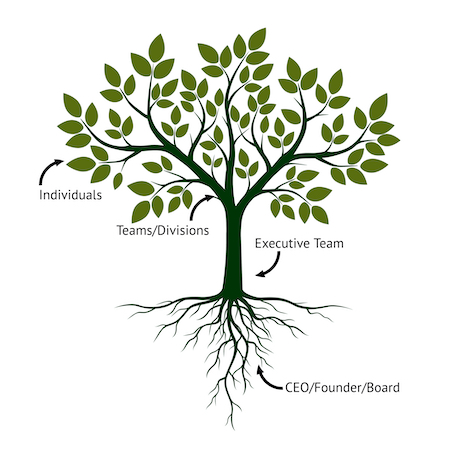
The most useful model I’ve encountered is the Tree Model of Decision Making. This is different from a Decision Tree, which you may be familiar with. The Tree Model is in fact an actual tree, while a decision tree is more like a pyramid, and not at all like a tree. 

If you think of all the decisions you need to make to run your business, from strategic to tactical to mundane, imagine that they lie somewhere on a tree. For our purposes, we’re going to be even more specific, and imagine that it’s a deciduous tree, else this analogy won’t take root (see what I did there?).

Speaking of roots…

In the roots are the fundamental decisions that decide what shape your company will take. What do we stand for? Who do we want to be?  Getting these right makes other decisions easier, plants you on solid footing and gives you a strong foundation on which to grow. These decisions lie with the CEO, the founders, and the board.

In the trunk are the decisions that decide the direction of the company. What products are we developing this year? Who are our customers? What are our key operating priorities? What is our overall operating budget this year? These decisions fundamentally shape the future of the company where it’s headed. Get these wrong, and it takes a long time to right the trunk. These decisions lie with the executive management team, and are typically decided once a year in a strategic offsite (and sometimes revisited every quarter to confirm that that your fundamental assumptions are still correct).

In the branches are the decisions that lie with teams and divisions – marketing, sales, engineering, HR, finance, manufacturing, and so on. Given who we are, and where we are headed, what are the departmental priorities for the year? Where should we focus our marketing spend? What’s our strategy for attracting and retaining key talent? These decisions are typically domain specific, and when they are well executed, contribute to the health of the tree. Unlike a trunk decision, if you get one or two wrong its painful and may require pruning,  but the core business remains healthy. Get a lot of them wrong though, and the health of the tree is at stake.

Out in the leaves are the day-to-day decisions, made by individuals, that keep the business healthy and moving in the right direction. If you get a couple of these wrong, the leaf falls off and a new one grows, but you want to have systems in place to make sure, say, half the leaves don’t take leave. Examples of leaf decisions are things like, should we give this customer a refund? What brand of camera should we buy for the social media team? What color should we paint the boardroom? As the CEO, the less involvement you have in these decisions the better, else you quickly become the bottleneck and slow things down. Try to set guidelines and budgets so that individual employees can make smart decisions without having to go through multiple levels of approvals.

I love simple frameworks like these because they give you and your management team a common language. When a decision arises in your weekly management meeting, you can refer to the framework – is this core to the business, and something that needs to be decided by the management team, or can it be delegated to a team or an individual? Straightforward frameworks should help you execute faster and reduce bottlenecks.

Did you find this model useful? Or is there another that your team uses to determine how and when to delegate decisions? Let us know in the comments.

Leave a comment

One-to-one meetings (sometimes called a One-on-One, or 1:1 meeting) are a staple in almost every manager’s calendar. They’re a fundamental pillar of effective management, and a key tool for driving performance. I believe it’s one of the most important tools you have at your disposal, and if you could only do one thing to improve your team’s performance, it would be to make better use of your one-to-ones.

From handling difficult conversations, to turning up unprepared, there are a number of pitfalls that managers fall into. So how can you ensure that your one-to-ones are actually effective? How do you get the most out of them?

Here are a few ideas drawn from my own experience as manager, and coaching first-time and experienced leaders alike. But first, what exactly is a one-to-one and why is it important?

What Is a One-to-One Meeting?

A one-to-one meeting is a regular, scheduled meeting between a manager and their direct report. You’ll meet to discuss progress, ongoing priorities, and roadblocks anywhere from 45 minutes to 1 hour at least twice a month, if not every week. It can be intimate and free-flowing, but as a manager you need to make sure you cover a baseline of topics, and are asking the right questions for both you and your direct report to get the most out of the meeting.

It’s also important to remember what a one-to-one is not – it’s not a status meeting. You should have other systems in place, such as team meetings, project tracking, and status emails that tell you the overall status of ongoing projects. A one-to-one is about developing your team and uncovering roadblocks, not getting updates.

Why Are One-to-One Meetings Important?

One-to-one meetings are crucial for effective management because they’re the foundation of regular communication between you and your employee. They provide a space where you can learn about their work, share feedback, and coach them on what’s working well and what’s not. This regular communication is crucial for building trust and addressing any issues that might adversely impact their progress.

One-to-ones are also an opportunity to develop your employee’s career. Employees usually have goals they’re working towards, even if they are not documented in a formal performance review. One-to-one meetings provide space to talk about these goals and support your employee on their path to success.

The outcome of one-to-one meetings is actionable next steps for both parties. You will leave the session with a clear idea of what you need to do to help them progress, and they’ll be more aware of your expectations for their role.

How to Structure Effective One-to-One Meetings

Effective one-to-ones are about creating a space for your team members to give honest feedback on what’s working well, where they’re struggling, and how you can help them perform better in their role.

One of European soccer’s most decorated coaches stated that one-to-one meetings were an integral part of his management style. In his management coaching sessions with Harvard Business school, Sir Alex Ferguson, who won multiple trophies throughout his career, explained how his players benefited from 1:1 meetings – the players thrived knowing they had the ‘coach’s shoulder.’

Having these conversations away from the rest of the team paid dividends for Ferguson’s results on the field. Similarly, engaging with your staff will likely prove equally as fruitful.

Here’s how to ensure your one-to-ones are as effective as possible.

Optimal 1:1 Agenda

When conducting a one-to-one meeting, it’s essential to have a set agenda. Setting an agenda will allow the discussion to flow organically, rather than simply be a status update. Again, if you cycle through the employee’s task list in a one-to-one session, you risk eating up time and failing to identify the real issues, ultimately preventing great results.

The First 5 Minutes

How you start the meeting determines whether you’ll engage in a productive dialogue or whether it will stay at a surface-level.

First, it’s paramount to create a safe environment for your team members, so take care with how you start out the one-to-one – don’t jump into discussing work right away.

Ask about things outside of work. How’s their family? What did they think about the game last night? Do they have any kids? If so, where do they go to school? Life doesn’t start and stop at work, and life outside of work affects how people show up at work.

Good leadership is about showing people they are valued. Ensuring your team feels supported will not only result in a positive work culture but will also encourage them to deliver their best. After all, if your employees feel you’ve got their back, they’ll reciprocate and want to be successful for you and the rest of the team.

Challenges and Roadblocks

Next, ask open-ended questions to understand the key issues that might be impeding their progress. It can be tempting to go into solution mode, but the aim is to prompt the employee to come up with their own answers. You are there to guide and help the staff learn and grow. If they cannot think of any challenges, or are hesitant to bring them up, ask more direct questions such as, “how do you feel about your upcoming deadlines?” or “how are things going with your new hire?”

Current Priorities

This part of the meeting not about getting project updates – it’s about helping your team set priorities. In most businesses, there are more projects and new ideas than there are hours in the day. Even the most disciplined employee can take tangents and get distracted by shiny new ideas. This is your opportunity to talk through their current project list and understand how they set priorities. Some of the best coaching opportunities come from helping your staff align their priorities with those of the business.

Career goals and personal development

Too often managers skip this step, which can leave people feeling like there’s nowhere to grow in the organization, or that you don’t care. Not every meeting needs to talk about career goals (though you should be touching on this at least 4 times a year), but you should be talking about some aspect of their personal development. For example, if they are struggling with having difficult conversations, and have committed to work on it, now’s a great time to follow up – what did they take away from the book you recommended? How did their last difficult conversation go?

The Wrap Up

The final step in a highly effective one-to-one is review the key takeaways and agree on commitments. Ask the employee – “what were your key takeaways from this meeting?”  Letting them summarize the meeting, rather than you, is a great way to see if you’re on the same page. Then ask “what are you are actioning from this meeting?”  Having someone articulate, in their own words, what they are committing to, often has a very different outcome than you telling them what to do.

Avoid Common Traps

There are a few common pitfalls where one-to-one meetings can go off the rails. Here are four to look out for:

Avoid jumping straight to solutions

You know what people say about when we assume things.

This is your opportunity to understand what makes your staff tick, how they think about their work, and what might be holding them back. Don’t assume you know what they are thinking and feeling, and jump to conclusions about what they need. Ask clarifying questions. Dig deep.

Don’t ignore your high performers because they are “low maintenance”

Another dangerous assumption is thinking your high performers don’t need a regular 1:1 conversation. Every member of the team has blind spots. It’s tempting to focus all your time and energy on employees you feel need the most help or might be underperforming. Remember, it is the strong performers that you’re trying to retain. Don’t let yourself fall into a situation where key players exit the firm due to a lack of engagement from higher management because you labelled them “low maintenance”. 

Show up

Be present. One-to-ones only work when you devote your full attention. Silence your phone and close your laptop. Try to use a paper notebook so you’re not tempted to look at your emails and Slack messages. Try not to be thinking of the next thing to say, and try not to dominate the conversation. If you’re talking more than 50% of the time, it’s an at-versation, not a conversation.

Try not to take on their work

Employees who fail to follow through on objectives might try to shift the blame, or shift the responsibility back on you. For example, ‘I haven’t got the answer I need from marketing, can you help?’ The team member is putting the onus on you to fix the issue. Don’t let them put that responsibility on your back.

Teach your team that they are ultimately accountable for the work. If they are not getting the answers they need from other departments, or from clients, it’s on them to follow up relentlessly to get what they need. If you start taking on that responsibility, not only are you teaching them that they have an out, but you will ultimately become the bottleneck as you chase down issues for your team.

Final Thoughts

We hope this article has been enlightening, and you can take something away to improve your 1-on-1’s. Remember, the key to having effective meetings is that you are prepared, focused, and present. It doesn’t have to be perfect the first time. Try this agenda, keep these strategies in mind, and iterate your way to success. The most important thing is to make them a priority.

If you are new to 1:1s, or you feel like you’re not getting the most of the 1:1s you’re having with your team and would like to have a focused coaching session to dive deeper into 1:1s, email me at matthew@spark-insights.com

Leave a comment

Effective Interviewing (or how to REALLY get to know someone in 60 minutes)

Hiring is a funny thing – no where else in life do you choose a partner for a long-term, co-dependent relationship based on an hour-long conversation. Thankfully, there are some proven tactics you can use to get the best possible sense for how a candidate will behave on the job, however they do require some work up-front and some discipline when it comes to the interview.

Preparing for interviews and planning your questions

70% of your success lies in this step. The goal of preparing interview questions ahead of time is to make sure you compare candidates on equal footing, and to help you stay on track in the interview. Have you ever concluded an interview only to realize that you chatted for 10 minutes about their experience, but had a great 20 minute chat about the NHL playoffs?

To start creating a list of interview questions, dig out the job description you wrote for the posting. Using the preliminary job description as a starting point, list the essential job functions – the 6 to 10 tasks, goals, or projects that the new hire will focus on day-to-day. For example, a few essential job functions for a VP of Sales might be:

  • Create the yearly sales forecast and break the forecast down into team and individual sales goals
  • Build the overall sales strategy for the company
  • Create and maintain sales funnel metrics to track overall progress

Again, you should have somewhere between 6 and 10 essential job functions for a given job.

Now, for each essential function, list out the technical skills and work habits required for each of those functions – 1 or 2 for each function. Technical skills are WHAT a candidate needs to know to do the job, while work habits describe HOW they perform in a job. For example, if you were hiring a social media coordinator, and an essential job function is to update the Instagram account daily, a technical skill would be “digital photography” and a work habit would be “self-organizing”. When you’re done, prioritize the list and you should have around 5 skills and 5 habits that are a must for the role. You’re ready to start crafting your questions.

Behavior-based interview questions

Behavior-based interviewing isn’t my idea – rather it’s the central theme of an excellent booked titled “High Impact Hiring”. In my opinion, behavior-based interviewing is the least error prone and most effective interviewing method for technical managers.

Candidates are savvy – they’ve read the books, been to many interviews, and are locked and loaded for the “what is your biggest weakness” questions. The purpose of behavior-based interviewing is to dig into the candidate’s behavior – how do they behave on the job? Past behavior is an indicator of future behavior. The trick is to dig beyond what they want you to hear and find specific examples of how they handled tasks and situations on previous jobs.

From each job function you should have about five technical skills and work habits. For each of these skills and habits, you need to come up with at least two questions (for a total of around 10) that help you determine if this person meets your criteria. Use open-ended questions rather than closed-ended questions.  

Open-ended questions start with: “Give me an example of” or “tell me the story about”. An open-ended question gives the candidate the opportunity to describe behaviors in their own words.

Avoid closed-ended questions such as: “Do you have experience working with Salesforce?” or “Have you ever worked in a fast-paced environment?”. When confronted with a closed-ended question, the candidate will tell you what you want to hear, and nothing more.

Behavior-based interviewing requires that you train the candidate to respond with behavior-based examples. Typically, candidates answer questions with a characteristic, for example, “I’m a good problem solver”. If you dig a little more, they might answer with a general process or testimonial, for example, “In my last job I successfully solved a lot of problems using a problem solving method I learned in school”. Pressed further, they may talk about “what we did at Acme co” (as opposed to “what I did at Acme Co). All of these rely on the candidate’s own view of themselves, or their ability to sell themselves – both completely useless to you. None of these responses tell you “does this person really know what they say they know”.

What you need is a behavior-based description – a story recalling a single event with considerable detail what they did given a certain problem or situation. You can train the candidate by asking them open-ended questions built around a handy acronym – STAR: Situation or Task, Action and Result. For example: “Tell me about a specific time when you used your problem solving skills. Tell me about the Situation or Task, what Action you took, and what the Result was.” Keep digging – ask for more detail and rephrase the question until you find out what the real action and result was.

Beyond behavior-based interviewing, here are a few other tips we’ve picked up to getting the most out of every interview:  

Use silence to your advantage. Silence is uncomfortable, but fight the urge to  help the candidate along and give them hints about what you’d like to hear; let them know they have time to think and let them formulate the answer.

Interrupt to maintain control: Mom always taught you that interrupting is rude, but in an interview, you have to interrupt from time to time to make sure you get through the full set of questions. If you run out of time with seven questions unanswered, you will have no way of comparing this candidate on an equal, objective footing.

Never answer your own questions: It’s tempting sometimes, especially if the candidate is keen, to give hints or help answer questions. Let the candidate sweat it out if they don’t know the answer. Give them a reasonable amount of time (a minute) to answer and move on to the next question. If they don’t know the answer, it’s not your responsibility to teach them either.

Pressure cooker questions: I like to introduce a question or two that is a little uncomfortable to answer, but will give me some insight into how they work with others. One of my favorites is “what did you and your manager disagree on most often?”. The key is to not let them off the hook. Their first answer will almost always be “nothing, we got along great”, to which your follow up should be “Of course, but there has to be something on which you didn’t see eye to eye”. Their answer can give you interesting insights into how they manage conflict.

The Impossible Question: The Impossible Question is something I borrowed from Microsoft and Joel Spolsky. It’s fallen a little out of favor lately, but I still like it as a way of judging how open-minded someone is, and how they react to challenges. It’s a question the candidate will have no hope of answering correctly, which gives you a strong indication of how they will react to tough problems. An example of an impossible question would be, “how many gas stations are there in Philidelphia?” or “how would you move the Washington Monument to Los Angeles?”  A smart candidate will realize you’re not quizzing them on their knowledge, and enthusiastically jump into trying to solve it – these are the people I look for. Others will look at you like you’re crazy, and will need a lot of prompting. An important thing to note is that The Impossible Question is NOT a puzzle or a brainteaser. Brainteasers tell you nothing except whether or not the candidate has heard the puzzle in the past.

Leave time for their questions: One of the most insightful parts of an interview are when you turn it over to the candidate and say “What would you like to know about working here? Ask me anything”. What they ask (and don’t ask) tells you a lot about their values, and about how well they prepared for the interview.

In the next (and final) installment on hiring, I’ll dig into how to decide among candidates, how (and why) to do reference checks, and making the offer. Stay tuned!

Leave a comment

Screening resumes

If you’re lucky, you’ll receive lots of eligible resumes, but everyone dreads the drudgery of screening resumes. Hopefully, your self-screening tactics have whittled the number of resumes down to dozens, rather than over a hundred, but still, that’s dozens of resumes to read and evaluate. Here are a few tips to make the process a little less painful.

When you’re screening resumes, don’t try to jump straight to a Yes or No on the first pass. You’ll find yourself reading, and re-reading resumes and either throwing out too many or including too many to interview. It’s really hard to tell if someone’s a fit based on the resume. At this stage, you’re just trying to stack-rank them so that you can prioritize your interviews. Instead of a Yes/No, grade them from AA to D:

  • AA: Wow. Looks like exactly the person you were looking for. E.g., has exactly the right amount of relevant industry experience (you’ll probably only have a few of these)
  • A: Relevant experience, at the right level of responsibility; no red flags
  • B: Some experience, but maybe a little more junior than you were looking for or not quite the scope of experience
  • C: Has some of the right experience, but there are some red flags, like jumping from job to job, resume typos
  • D:  Not enough experience, the wrong kind of experience, or a poorly written resume

If you don’t have a resume-tracking tool or hiring portal, an easy way to manage the process and keep them organized is to put all the resumes in a folder, and rename the file leading with your ranking. For example, “B_JohnDoeResume”. You can add a suffix to keep track of where they are in the process, e.g. “B_JohnDoeResume_screened”.

Trust your gut. Don’t overthink it, or you’ll be at it for days. Only go back and do a second pass if you find yourself putting everyone in the B category, or if you end up with more than a few AAs and As.
Hopefully you have 2-3 AAs, and something like 5-7 As. Set up a screening interview with these candidates first. If you eliminate too many in the screening process, you can always move on to the more promising B candidates, but chances are your final candidate is somewhere in this initial list.

The screening interview


You can save yourself a considerable amount of time by screening candidates by phone before conducting face-to-face interviews. There’s nothing worse than spending an hour or more in an in-person interview only to find out they can’t move to your location, don’t really have the experience they are touting, or aren’t interested in working on your product.  Phone interviews should be no more than 20 minutes, and should mostly be focused on verifying the facts on the resume – current position, current responsibilities, basic contact information, location preferences, willingness to relocate, and salary expectations. Take a few minutes to ask them about their current role and responsibilities. There’s no need to go too deep here, rather, try to get a sense of whether they are embellishing on their resume, or if they do really have the level of responsibility they are stating in the resume.

The screening interview also gives you the opportunity to gauge their communication skills, both in the process of setting up the phone call, and the call itself. How quickly did they respond to your email requesting a phone call? Was their response succinct and well written?

Incorporate one question that helps you determine if they have the single most important technical skill for the role. For example, if you’re hiring software developers, it might be a question to determine if they really understand OO programming. If you’re hiring automotive technicians, it might be a question about how they’d diagnose a tricky non-start condition on a specific make/model.

Next week we’re going to dive into the interview – how to prepare questions, how to really dig if you’re not getting the right level of detail from a candidate, and dos & don’ts for the interview itself.

Leave a comment

As I write this, we’re in what we hope to be the tail end of the pandemic. Businesses are reopening and hiring (or if you’re in certain industries like Powersports, you’re having a record year). Several of my clients have asked me to either help them hire for a key position, or to help coach and train their team on effective interviewing and hiring. Over the years, and over countless hires (and even more interviews), I’ve tried to refine my hiring process to make it more repeatable and less error prone. Hopefully, you too are hiring, and this process can help you make your next hire a little easier. Here’s Part One – laying the groundwork and creating your job posting.

The groundwork – writing the job description and the posting

The key to successful hiring starts with a solid job description. Not only will it help you write a posting that attracts the right candidates, but it will help you build your interview questions. The job description needs to include: 

  • Title
  • Primary tasks and duties
  • Responsibilities and authority
  • Reporting relationships (who will their manager be?)
  • Qualifications and characteristics (what skills and personality traits do you need for this role?)
  • Desired experience
  • Organization level (Jr., Intermediate, Manager?)
  • Education requirements
  • Salary range

These bullet points give you all the information you need to write your job posting, but describing the job is table stakes. Despite what the media may tell you, qualified talent is scarce. Your job posting needs to stand out. Don’t be dry. Let the personality of your company come through. Tell applicants why you’re a great place to work, and what to expect from the culture.

Let your candidates help you screen the resumes

Screening resumes is a drag. With any luck, you’ll get dozens or hundreds of applicants, and trying to whittle that down to 5 or 6 people you want to interview can be really time consuming.  Make this more manageable by having the candidates do this for you.

Whenever I post a job, I try to devise a way to separate the people who are genuinely interested from the people who are just carpet-bombing companies with their resumes in hopes of a hit. In the job posting, I include – in plain sight – detailed instructions of how to apply for the job. For example, I might say that we only accept applications through email, and that we don’t want a separate cover letter –  instead, write us an email, and we’ll only accept resumes in PDF or Word format. Anyone who doesn’t follow the instructions, I immediately delete. It might sound counterintuitive,  but that self-eliminates the bottom half of the applicants. My theory is, if you can’t follow simple instructions, or you can’t take the time to read the whole posting, I don’t want to work with you. From time to time, to test my theory, I’ll interview a candidate who has a decent resume but didn’t follow the instructions. In every case, the interview was a waste of time. The candidate either lacked attention to detail, had a sense of entitlement, or had a massive ego.

I’ll also make a second ask to help me narrow the field down further. If I’m hiring for a specific skill-set, say a designer or a writer, I’ll ask for samples or a portfolio. In other roles, I’ll simply ask them to write an email describing why they think they are a fit for the role, and why they are passionate about the industry. Another 10% of  applicants won’t follow the instructions, which I immediately delete. For another 10%, their portfolio or samples won’t be up to par, or their email will be poorly written or simply sloppy (punctuation anyone?). Before even starting to screen resumes, you’ve already eliminated 70% of the work.


Where to post

Where you post your job depends on the type of skills you’re looking for. Overall, I find LinkedIn works best for knowledge-based roles and management positions, especially if you pay to boost the posting and broadcast the job to your LinkedIn network. Many of my clients have had good luck with Indeed, and for technician roles or entry-level positions, you can’t beat Craigslist. Make sure you post the job to your company website, and encourage your staff to share the job posting to their social media networks. Often the best candidates come from staff referrals.

In the next article, I’ll show you how to make it easier to screen and track resumes, and how the screening interview can save you a ton of time in the interview process.

Leave a comment

I first wrote this article 10 years ago, and recently came across it in my Evernote files. Since then, I’ve graduated from working inside growth companies to coaching CEOs of growing companies, and I’m in the process of graduating from track days and time-trials to door-to-door racing. Reading the article 10 years later, I realized these same lessons ring true, and that I’ve learned a few things along the way, so here’s version 2.0. Enjoy!

I love analogies, but for years I’ve listened to my colleagues in Canada relate every business lesson to a hockey analogy. Everything will work out fine if we just “skate where the puck is”. Working now in the US, everything is a football analogy – “we need more team members who are broken-field runners”. I do enjoy hockey and football, but I barely know the difference between an offside and icing let alone who won the Stanley Cup in ’72. Half of the time the analogy is completely lost on me.

So in an effort to bridge the communication gap, I’ve related my learnings in business to one of my passions – auto racing. I hope this helps other business-minded gear-heads communicate more fluently with their peers, and if nothing else, I’ve laid the foundation for you to take your team to the Skip Barber racing school for “team-building”.

Look where you want to go
One of the deadliest errors, often made by beginners on the racetrack but occasionally made by experts, is called “Target Fixation”. In a moment of high stress, your brain is so overloaded that it becomes fixated on exactly what you are trying to avoid – gravel in a corner, an obstacle, or another car. You end up hitting it square on.

In business, it’s very easy to get fixated on what you don’t want – losing a key customer, a market downturn, your best performer leaving. More often than not, you run straight into what you were trying desperately to avoid. It almost happened to me in a previous business in the so-called “Great Recession”. Around 2009, our pipeline was drying up, and in a sombre management meeting, we told ourselves “I guess we’d better start planning to downsize”. Luckily, one of our mentors snapped us out of it. He wouldn’t let us even mention downsizing until we had exhausted every possible option for filling up our project pipeline and hitting our revenue targets. It was every man on deck. He refocused us on the positive outcome, and guess what, we turned it around and headed straight into our best year in history.

To be a great auto racer, you need to have “wide eyes” – you learn to look far ahead, use every corner of your peripheral vision, and look where you want to go. Being a leader is no different – your job is to look further than tomorrow, get a lot of advice and input, and keep your team focused on where your business is headed.

It’s a mental game
Time and time again, I hit a plateau at the race track. I think I’ve wrung every last bit of performance out of my car and driving to my absolute abilities. Then I invite a very fast, very experienced driver to drive me around the track in my car. After a warm-up, they do a few blistering hot laps, a full 2.5 seconds faster than I. We returned to the pits, review the session, and he sent me on my way. The very next lap, I was 1.5 seconds faster, and the next 5 laps I was consistently 2 seconds faster than my previous laps (I’m still chasing that last few tenths, and that’s what makes racing so fun). It wasn’t the car, or even my abilities that was slowing me down – it was my mental model of what was possible.

Success in business has a lot to do with your mental attitude. Studies have found strong correlations between entrepreneurs with positive outlooks and business success. Most of the time, it’s not your competition or the economy that’s holding you back, it’s your own attitude and beliefs. Those that have an attitude of abundance generally outperform those that believe the glass is half-empty.

Persevere

shunt

A minor shunt. It’ll buff out.

In racing, no matter how practiced and prepared you are, you can suffer dramatic setbacks. Parts break, someone bumps you, or for whatever reason, your perfect setup just isn’t working on a particular track like you thought it would. Even world-championship teams have bad weekends. The best drivers have persevered through dozens of bad weekends. They learn, they adjust, and they go try again.

The business press loves the “overnight success story”. What they fail to mention is that behind almost every business success is years of blood, sweat, and tears. Yes, one day they break through, but often these overnight success stories have been at it 10, 20, or even 30 years before they became a household name. Every business had failed starts, bad sales calls, unproductive employees – you name it. Things that are completely out of your control hit you from left field. The only thing you can do is dust yourself off and keep going. So much of success in business is just showing up and trying. If you’re self-aware and inquisitive, you’ll learn with every setback, and one day you’ll wake up amazed at the progress you’ve made.

Change one thing at a time
There’s a popular business mantra that says “you can’t manage what you can’t measure”. I also believe that to measure change, you can’t change everything at once.

In a growing company, you will always looking for things to improve. As you grow, you’ll find it increasingly difficult to apply measure progress when you’re changing so many things at the same time.

In racing, we only change one thing at a time, and test it’s effect. You change your sway bar settings on one end of the car, and you go test. You adjust your shock absorber rebound, and you go test. If you were to change all those things at once, and you spun in turn one, you’d have no idea what caused it, and lose precious hours going back to square one.

The same is true whether you are changing a business system, or changing an attribute of your product or web site. If you change your customer acquisition strategy, launch a new web site, and restructure your sales team all at the same time, you’ll never know which one moved the needle.

Win together, lose together

coaching

Coaching session with racers360.com

Even at the amateur level, successful racers have coaches and mechanics. At the professional level, teams spend an enormous amount of time learning to work together in perfect harmony. They know that everything, from the pit crew who refuel the car in seconds, to the suspension engineer who knows exactly how to set up a shock absorber for a specific track, have to come together flawlessly to win a race. Lewis Hamilton gets most of the press for winning 6 championships, but what impresses me most is how Toto Wolff and his team coordinate and motivate the hundreds of people that work behind the scenes to build and maintain a winning race car.

New leaders often believe they need to have all the answers. It’s ok to tell your team “I don’t know. I’m not an expert in this area and I need your help figuring this out”. On top of that, there is probably someone, somewhere who has gone through exactly what you are going through who is willing to help. In my career I’ve been lucky to have a few people who were willing to sit down and talk through a business challenge for nothing more than a latte and the promise to pay it forward.

Successful management teams are staffed with people who compliment one another’s strengths, and who think differently from one another – some big picture thinkers, some detail-oriented; some who are engineers and some who have arts backgrounds. Believe me, it’s not easy – you’ll disagree constantly, but in the end you’ll make better decisions because they’ve been dissected from every angle.

The really successful teams invest time and money learning how to communicate better and work better as teams. They set aside personal ambition and break down silos to achieve a shared vision. Like a championship race team, great teams are built with trust, shared respect, and communication.

If everything feels under control, you’re not going fast enough
World champions drive their cars at the very edge of control. A little more steering input, or a fraction more throttle, and they would go careening off into the weeds. It’s a strange sensation, to feel almost completely out of control, but at the same time, completely in control. Legendary driving coach Ross Bentley calls this “being comfortable with being uncomfortable”. The flip side of that coin is that once and a while, you will spin out (ask me how I know).

If you’re an auto racing fan, you’ve witnessed the two extremes – on one hand are the wildly aggressive drivers that lead one race by a half a lap, but crash out in the next one. They burn their teams out and burn their bridges. On the other hand are the backmarkers who are unwilling to be as aggressive as the winners. Champions find that perfect balance – they are blisteringly fast, take calculated risks, but are patient and persistent, tracking their opponents lap after lap, waiting for them to slip up so they can take the pass for the lead.

In business, I’ve seen companies who are unwilling to take risks, and unwilling to live on that edge of controlled chaos, and they usually plateau. I’ve also worked with companies that are in constant chaos, where the leadership team leaves burning bridges, burned out employees, and fried customers in their wake. The perfect flow is right down the middle – taking calculated risks, moving quickly, and working right in that zone where things feel a little out of control.

You’ll never have all the data and all the answers – a napkin-sketch plan passionately executed will beat a perfect plan poorly executed every single time.

Slow hands, fast car

The final, and most difficult lesson to learn for executives and CEOs is to lead with calm, patience, and perseverance. In a race car, it looks impressive to be attacking every corner beyond the limit, sliding the car, hands frantically correcting and sawing at the wheel. Typically this racer runs out of tires, or talent, and loses their lead to someone smoother. The same goes for business. The model we see on TV reality shows is the frantic, yelling CEO, driving everyone to the brink and leaving a wake of destruction. In real life, it’s a marathon. The toughest lessons for me personally, both on the track and in the boardroom, has been to remember to breathe, to listen, to seek to understand, and to slow down time when everything’s feeling out of control. The best leaders lead with grace and build confidence in their team, and are aware of the wake they leave.

And remember, if you’re still stuck on your hockey and football analogies – as Hemingway (or Ken Purdy, or Banarby Conrad, depending on who you ask) once said  “There are only three sports: bullfighting, motor racing, and mountaineering; all the rest are merely games.”

Leave a comment